
Tracing Roanoke County Former Owners
Start with a parcel, not a surname alone. The newest deed names a grantee and describes the tract in detail. That grantee then becomes the name you search for as an earlier owner. Roanoke County indexes deeds and land records from 1838 forward. Plats go back to 1838 as well. Related index groups begin later. Their image dates can differ from their index dates, so track both the record family and the year.
The main sources that reveal past owners each play a distinct role. The land index anchors the ownership chain. A plat fixes the lot in context. Probate files or a state death record often explain why an estate or fiduciary appears among the deeds. Not every book or image is online, so plan accordingly.
| Source | Years It Covers | Where Held | What It Shows |
|---|---|---|---|
| Deed and land index | 1838 to present, as advertised | Circuit Court Clerk / SRA | Recorded parties, instrument type, transfer and land description. |
| Survey plats | 1838 to present, as advertised | Circuit Court Clerk / GIS reference | Lot, block, boundary, and subdivision context. |
| Wills and fiduciaries | Index from 1994; images from 2001 | Circuit Court Clerk / SRA | Estate authority that may explain a later conveyance. |
| State vital records | Public index rules vary by record and age | Virginia Office of Vital Records | Eligible death-record route; a certificate is not a title record. |
Match the tool to the era. For a recent transfer, the land index and deed do the work. For an estate transfer, use the fiduciary record. It names the person authorized to act for the deceased. For a very old parcel, the Clerk's books help. Plat references lead back into earlier land descriptions. The Library of Virginia serves as an archive gateway. Its exact Roanoke County holdings require collection-level searching to pin down.
Roanoke County Deed Index Reach
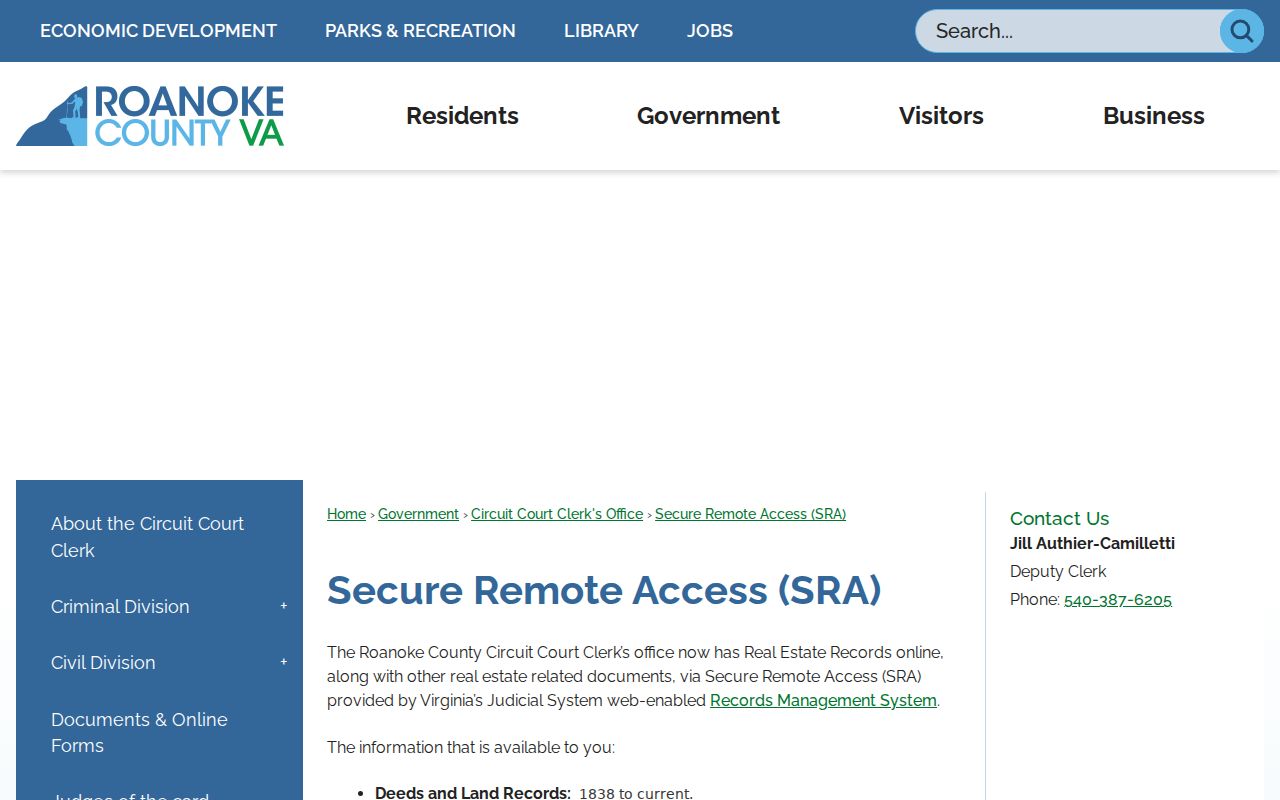
The county's Secure Remote Access description covers deeds and land records. These span 1838 to the present. Other categories start later. Financing-statement indexes begin in 1989, with images from 2001. General miscellaneous index material begins in 1877, with images from 2001. Judgments reach back to 1983. Wills and fiduciaries begin in 1994, with images from 2001. Never assume every record group shares the deed index's start date.
The Roanoke County SRA coverage page lists the published ranges and the subscription route. Access requires an approved application and agreement. Rates run $125 for three months, $250 for six months, or $500 for a year. The county does not state that every early deed image is available online.
When an image or index entry is missing, ask the Clerk about the underlying book, vault copy, or microfilm. Keep the date and prior reference from the most recent deed you could verify, so the trail never goes cold.
Roanoke County Book and Page Clues
Later instruments often cite an earlier book and page or instrument number. That creates a real shortcut. The county's cover-sheet rules tell a filer to include prior recording references whenever a document relates to an earlier filing. So a later deed points back to the earlier one. Capture the reference from the latest deed. Then search that specific prior entry instead of repeating a broad owner-name query.
Record every detail at each step: grantor, grantee, instrument type, date, book and page or document number, tax map, and legal description. A chain worksheet preserves the facts that appear on each paper. Never assume an online search result tells the whole story. A full deed file may hold more than the index shows.
Walking the Roanoke County Deed Chain
A chain of title is simply the ordered sequence of conveyances for one tract. Read each deed from its grantee back to its grantor. Then search for the earlier grantee who acquired the same land. A former owner can be a person. It can also be a company, a trustee, an executor, or an estate. The chain holds only when each record matches on land description and parcel clues. It must never rest on a name alone.
- Find the latest deed and note its grantee, grantor, date, and legal description.
- Search the grantor as an earlier grantee and locate the instrument for the same tract.
- Capture the prior book/page or instrument reference printed on the filing.
- Repeat, checking for name variants, entities, and changes to the parcel description.
- Ask the Clerk about a book, microfilm, or archive source when the online trail stops.
- Grantor / grantee
- The party conveying an interest and the party receiving it.
- Chain of title
- The sequence of records that documents interests in one tract over time.
- Legal description
- The lot, plat, or metes-and-bounds text that ties a deed to land.
Older Roanoke County Deed Books
The 1838 starting point for Roanoke County land records is unusually deep. Even so, the exact image cutoff for deeds is not published, and no guarantee exists that every early book is digitized. The county lists image cutovers for financing statements, general miscellaneous records, and wills or fiduciaries. Those separate dates show why an index year and an image year must be tracked apart. An online image may not exist just because a category's index reaches a certain year.
If the chain stops, contact the Circuit Court Clerk at 540-387-6205 or visit 305 E Main Street, Salem. Ask for the relevant deed book, microfilm, or archived index using the parties, year range, prior book and page, and parcel description. The Library of Virginia catalog offers another route through land books, maps, newspapers, and state-held collections.
Roanoke County Probate Transfers
Probate often explains why an estate or fiduciary shows up between two individual owners. The Circuit Court Clerk in Roanoke County handles wills and fiduciary matters. The SRA fiduciary index reaches back to 1994. Images begin in 2001. A will or an appointment shows who had authority to sell or distribute land, while an executor deed or recorded order ties that authority to the parcel itself.
Search the estate name and the person who served as executor or administrator. Then compare the deed's tax map and legal description against the probate file. Access rules for estate files can differ from an ordinary property search. A court order or partition can also change how heirs hold property without any routine sale between individuals.
Virginia Death Record Access
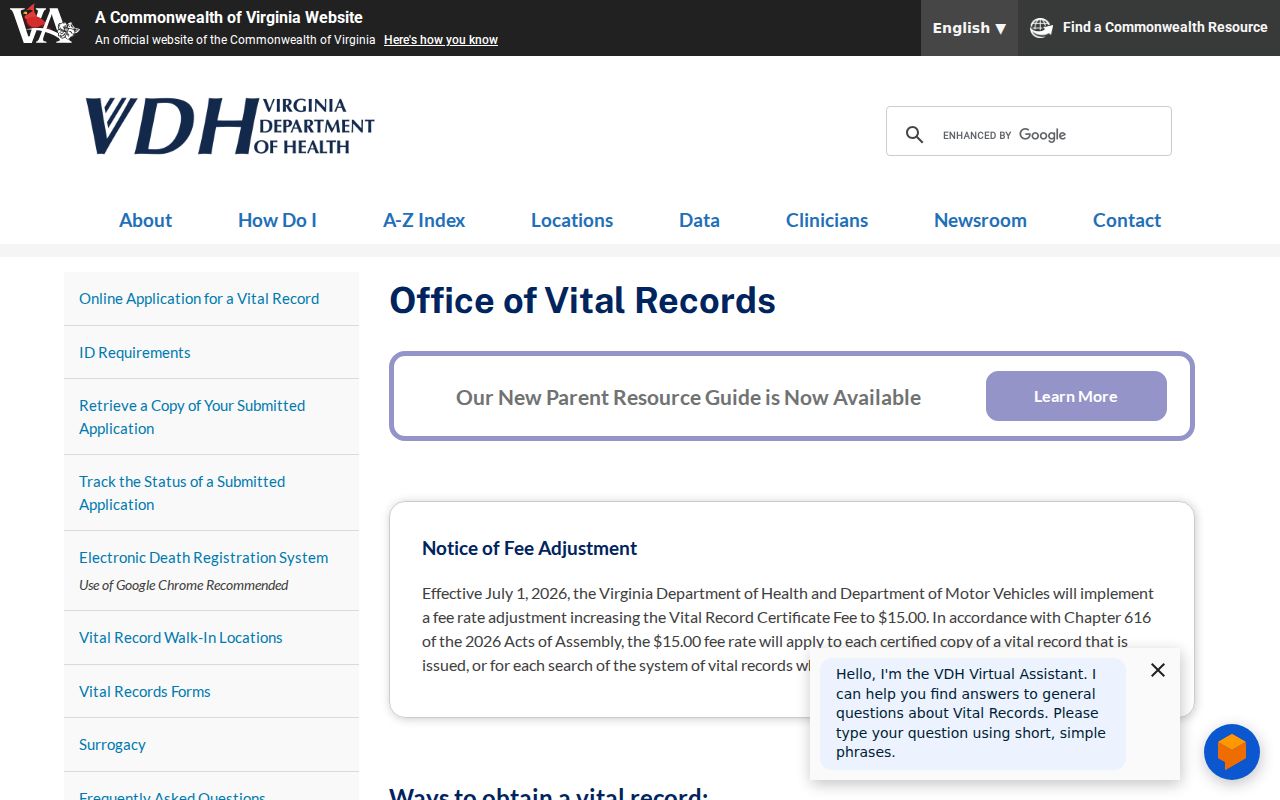
Virginia's Office of Vital Records is the statewide custodian. Death, marriage, and divorce records open to the public 25 years after the event, while birth records stay closed for 100 years. A certified copy requires a written request, proper identification, and eligible standing. Each search or copy costs $15. A certificate proves the death. It cannot prove who inherited the land.
The Virginia Vital Records page displays the state index and certified-copy service. Pair an eligible vital record with a Roanoke County will, fiduciary file, court order, and recorded deed. That cross-check explains the transfer.
Roanoke County Plats and Former Owners
A plat often reveals that an old tract was subdivided, renamed, or split into lots. Roanoke County records survey plats from 1838. A later deed may cite the plat. Compare the plat, block, and lot details to the current tax map before tying an old deed to a present-day parcel. Maps orient a search. The recorded plat and instrument hold the historical references.
Street addresses are weaker for old ownership work. Postal labels and site numbers change, and Roanoke County publishes no complete street-renumbering timeline or archive inventory. When an address fails, search prior grantor and grantee names, the legal description, lot and block, and references written on the deed itself.
How Far Back Roanoke County Ownership Goes
Roanoke County advertises land records from 1838 forward. That date is the documented public starting point. It does not promise an online image for every early deed or a complete pre-1838 chain of title. Older questions reach past one portal. Use the Clerk's archive guidance and search state catalog holdings by locality and record type.
Lawful use. Former-owner research supports house history, title review, and property diligence. Do not use a past or present owner's information to track, stalk, harass, or harm anyone.